Remember drawing treehouses or castles as a kid, sketching out every detail with chalk or pencil? That picture was your first general arrangement (GA) drawing that showed what you wanted, but didn’t say how much it would cost.
In real construction, GA drawings serve a similar purpose. They detail the design of your project, but don’t include prices. So, when you move from paper plans to building a cinder block wall, the big question becomes: what will it cost?
In this guide, we’ll break down the numbers and factors for cinder block or concrete CMU walls, so you know what to expect for your project’s budget.
Average Cost to Build a Cinder Block Wall in 2026
Below are typical cost ranges for building concrete cinder block walls. These figures include materials, labor, foundation, and reinforcements.
| Item | Cost Range (USD) |
| Cinder block (per block, material) | $1 – $5 |
| Wall (installed, per ft²) | $15 – $30 |
| Wall (installed, per linear ft) | $60 – $240 |
| 25′-long wall (6′ tall) | $2,250 – $4,500 |
| Cinder block house (total, per ft²) | $190 – $250 |
How Much Does a Block Wall Cost Per Sq Ft in 2026?
In 2026, a freestanding concrete block wall costs from $15 to $30 per square foot installed. This range assumes an average 6-foot height and includes materials and labor.
How Much Does a Block Wall Cost Per Linear Foot in 2026?
It is from $60 to $240 per linear foot (installed) for a concrete block wall. The wide range reflects height differences: a 4-foot front-yard wall is often $60–$120 per linear foot, whereas an 8-foot backyard wall can be $120–$240 per foot.
Construction vs Repair Cost of Cinder Block Wall & CMU
Building a new wall costs significantly more than repairing existing damage. The tables below compare new-construction costs with common repair or maintenance costs for block walls.
New Construction Costs: (Installed, with foundation and reinforcement)
| Scope | Typical Cost |
| Block wall (installed, per ft²) | $15 – $30 |
| Block wall (installed, per linear ft, 6′ tall) | $90 – $180 |
| Build a 25′ wall (6′ height) | $2,250 – $4,500 |
| Cinder block house (per ft²) | $190 – $250 |
Repair & Maintenance Costs:
| Repair Task | Cost Range (USD) |
| Minor crack repair | $200 – $500 |
| Repointing mortar joints | $300 – $1,200 |
| Partial wall section replacement | $1,500 – $4,500 |
For example, sealing a few small cracks may cost a few hundred dollars, whereas rebuilding a damaged section or replacing a short wall part can run into the thousands. In all cases, repairs are generally far cheaper than tearing out and rebuilding the entire wall.
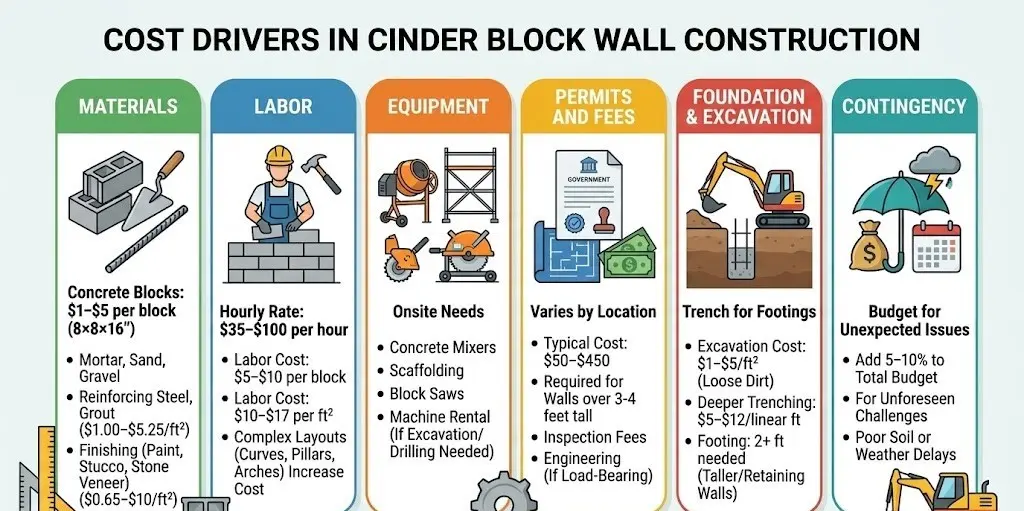
Cost Drivers in Cinder Block Wall Construction
Several key elements drive the overall cost of your wall project:
● Materials
Concrete blocks cost roughly $1–$5 each (standard 8×8×16″ block). You’ll also need mortar mix, sand, gravel, and reinforcing steel. Rebar and grout typically add about $1.00–$5.25 per ft² of wall. If you add finishing, which means stucco, paint, or stone veneer, factor in $0.65–$10 per ft² more.
● Labor
Skilled masons charge about $35–$100 per hour, which can vary by region. In per-unit terms, labor is roughly $5–$10 per block or $10–$17 per ft² of wall. Complex layouts, like curves, pillars, or arches, take longer to build and increase labor costs.
● Equipment
You’ll need concrete mixers, scaffolding, block saws, etc. For example, cutting blocks onsite adds labor-intensive work. If excavation or drilling is required, it will add machine rental and labor.
● Permits and Fees
Most cities require permits for walls over 3–4 feet tall. Permits typically cost $50–$450, depending on wall height and location. Don’t forget potential inspection fees or engineering if the wall is load-bearing.
● Foundation and Excavation
Taller or retaining walls need deeper footings. Excavating a trench usually costs about $1–$5 per ft² (loose dirt) or $5–$12 per linear foot for deeper trenching. Furthermore, more concrete and labor are needed for a 2+ foot footing compared to a simple poured slab.
Note: If you’re considering a slab foundation instead, our guide “How Much Will a Concrete Slab Cost in 2026: Prices and Insights” covers those costs.
● Contingency
Always include a 5–10% contingency in your budget for cinder block construction.
Or repair. This percentage is for unexpected issues, like poor soil or weather delays, which are common. For a deeper dive on budgeting for surprises, see our “Construction Contingency Guide” for tips.
Which Factors Can Affect the Cost of Cinder Block Wall Construction?
● Location
Labor and material costs of cinder block wall construction or repair vary by region. Coastal cities and high-cost states often have higher wages and permit fees. However, rural or low-density areas may be cheaper. Therefore, always check local supplier prices and contractor rates.
● Season/Weather
In winter or rainy seasons, construction projects slow down. Cold weather requires heating the mortar, and rain demands a halt to work, both of which increase labor costs. Similarly, summer heat also slows labor. Therefore, you must plan for possible schedule extensions to avoid issues later.
● Type of Wall
You know that different wall types have different needs. A simple cinder block fence is cheaper than a load-bearing wall. For example, block fences typically cost $15–$30/ft², while retaining walls, which need drainage and backfill, can be $20–$35/ft².
Similarly, a complete cinder block house, which includes foundation, framing, and walls, can reach $190–$250/ft², whereas just the block walls of that house cost about $10–$40/ft². For more on masonry construction types, see What is Masonry & Types of Masonry Construction?
● Foundation/Footing Requirements
Soil type and wall height dictate the footing in cinder block wall construction. Low walls, under 4 ft, mostly need minimal footing, but 6–8 ft tall walls typically require 1–3 foot deep footings. And you know that heavier footings use more concrete and labor, which increases the project costs.
● Finish & Waterproofing
Most block walls absorb water, so sealing or waterproofing is key in this project. Wall finishes range from simple paint, $0.65–$0.80/ft², to stucco, $3–$4/ft². Moreover, waterproof sealants cost around $2–$10/ft². These upgrades extend wall life but also add to the budget.
Can You Estimate the Cost of a Cinder Block Wall Yourself?
You can make a rough DIY estimate by using this formula:
Length × Height × Block/Unit Costs
Remember that it’s easy to miss hidden costs if you DIY. Homeowners often overlook items, like excavation time, concrete footings, permit fees, or required reinforcements in the estimates. This miscalculation can lead to costly overruns later.
For these reasons, hiring a professional estimator is usually a better choice. Experienced estimators providing construction cost estimating services will compile a detailed takeoff of blocks, mortar, rebar, labor hours, and more. They also include contingencies and local code requirements. In short, an expert estimate saves time and helps avoid budget surprises on the job site.
How Budget Estimators Calculate the Cinder Block Wall & CMU Cost
1. Measure and Quantify
First, they calculate wall area using the formula length × height, plus the block dimensions. Then, they convert to several blocks while adding ~10% for waste.
2. Estimate the Material Cost
Next, they multiply block count by unit price, which is $1–$5 each. This is followed by adding mortar, sand, gravel, and rebar costs, which are about $1–$5.25 per ft² of wall.
3. Labor Cost Estimation
After materials, estimators determine the skilled labor needed. They use local masonry rates, roughly $35–$100/hour, which is about $5–$10 per block or $10–$17 per ft².
4. Foundation/Footings Cost Estimation
Next, they include excavation and concrete. Excavation costs ~ $1–$5/ft²; trenching costs about $5–$12/linear ft. They also estimate concrete volume for footings with a depth typically 1–3 ft for tall walls.
5. Finishing and Extras
Then, teams add costs for wall finishes or waterproofing. This ranges between $0.65 and $10 per ft², depending on the choice. In this phase, they also factor in any special features, like caps, stairs, and gates.
6. Permits and Overhead
Building permits often cost $50–$450, depending on location. Therefore, professionals include general contractor fees or profit margins as needed.
7. Contingency
Finally, they add about 5–10% extra for unforeseen issues, like weather delays, soil problems, etc.
By summing all these components, masonry or concrete estimating services give a comprehensive budget. Estimators often use estimating software to ensure no item is overlooked and everything is accurate.
Don’t Leave Your Budget to Chance—Get a Professional Masonry Estimate Today!
FAQs
How can you save money on cinder block wall construction or repair?
Plan for simplicity, as a straight wall with a uniform block is cheapest. Also, buy blocks in bulk, do prep work yourself, like site clearing, and avoid expensive finishes. Moreover, reusing straight sections or doing minor DIY repairs, like sealing cracks, also cuts costs.
What is the size of a cinder block?
The most common cinder (CMU) block is 8 inches × 8 inches × 16 inches. Actual dimensions are slightly less to allow for mortar joints.
How can you build a cinder block wall?
- Start with a level concrete footing.
- Mix mortar and lay the first course of blocks, staggered like brick.
- Fill vertical cores with rebar and grout as you build, using a level to keep it straight.
- Continue until the wall reaches its planned height, adding a bond beam or cap blocks on top for strength.
How tall is a cinder block?
Standard cinder blocks are 8 inches tall, excluding mortar joints. Include a typical 3/8″ mortar joint; each course is just over 8 inches.
How much do cinder blocks cost?
It is about $1 to $5 per block. Special blocks with split-face, color, or corners cost more. Buying by the pallet, 70–90 blocks, usually runs $115–$225 per pallet.
Conclusion
Building a cinder block wall involves many cost factors, including block and material prices, labor rates, wall height, finishes, and site conditions. Therefore, plan on roughly $15–$30 per ft² or $60–$240 per linear foot installed. Remember that specific features, e.g., retaining walls or detailed finishes, will push you toward the higher end of those ranges.
Also, repairs like crack sealing or mortar repointing cost only a few hundred dollars, which is much less than building a new one. To get these estimates right, consider using our expertise. Masonry estimating services at Cost Estimator bring detailed, accurate budgets for block walls and other projects.