A garage is more than just a parking space. It insures your vehicle, provides storage, and increases property prices. The truth of the matter is that garages can make a house sell at a higher price 10%-15% than other houses.
It is not easy to make the correct choice of size. Many homeowners find it hard to achieve the right balance between space, budget and functionality. This is the reason why the 2 car garage dimensions should be studied before planning or building.
Here, you will get to know about the standard sizes, layout choices, and cost considerations. You are also going to learn how to select the ideal size of a garage that will suit you.
Before finalizing your garage dimensions, it’s important to understand the overall cost to build a house and how the garage impacts your total construction budget.
What Are the Standard Dimensions of a 2 Car Garage?
The 2 car garage will be designed to fit two cars without cramming within the vicinity, space to walk around and store items. But this is said to be the minimum. The majority of new garages are larger in size because the size of the vehicles has increased. More than 60% of cars that are sold in the United States are currently of the SUV and truck vehicle type, and hence more width and depth are often needed.
Normal 2-car garage dimensions measure 20×20 feet and 24×24 feet and averages size is approximately 480-576 square feet. This dimension is more comfortable, there is more storage space, and flexibility in the future.
The appropriate choice of dimensions would depend on the size of a car, your storage needs and your financial means. A slightly bigger garage will go a long way in ensuring your day-to-day life is made easy and in the long run, the value of your home is increased.
Since most 2-car garages are built on a slab foundation, checking the current concrete slab cost will give you a clearer idea of the base expenses.
Standard 2 Car Garage Width and Depth
The selection of the size is essential since it is important for comfort, safety, and functionality. This is because a 2 Car Garage of the right size enables you to park cars, open the door, and even store tools or bikes without any problem.
Typical 2 Car Garage Width
A 20 to 24 feet width is the standard width of a 2 Car Garage. This allows sufficient space to each vehicle and also allows additional room to work on a vehicle or store. Using a typical example, the width of a car that is 6-7 feet wide would give a garage that is 20 feet wide and the equivalent of that to the side in the case of a garage would be 3-4 feet, enough to comfortably open the door easily.
Standard Depth Requirements
Breadth is also one of the most essential aspects. Most of the 2-car garage sizes imply a depth of 20 to 24 feet. This will create room not only to accommodate the needs of the vehicle but also to house the rear, trash cans or shelves. The underground garage can lead to tight and uncomfortable parking space especially when there are SUVs and trucks.
Space Needed to Open Doors Comfortably
To avoid banging doors against walls and other objects you must have at least 3 feet of free space on each side of a car. This is what can fit in a usual small garage of 20 by 20. A larger garage with 2224 or 2424 would be required to be sure that there are no scratches, easy access and exit.
Allowance for Walking Space
The space of walking should not be disregarded because it is very crucial. It is suggested that the distance between cars should be spaced at 2-3 feet in order to comfortably move. This will help the homeowners to get the space to keep the storage, ladders or work benches without getting crowded by having to squeeze through small doorways.
You can use our house construction cost calculator to compare how different garage dimensions impact your overall building budget.
Typical 2 Car Garage Size Options
When designing a garage, it is always good to be aware of the typical 2-car garage size models so that you can balance space, price, and utility. The size will be different based on the fact that you own different types of vehicles, a storage facility, and the overall design of the house.
20×20 Garage
The average2 car garage size commences with 20x 20 feet which amounts to 400 square feet. This is the most appropriate size that fits compact cars or sedans.
Pros:
- Cost-effective and quick to build
- Fits most standard vehicles
- Requires less lot space
Limitations:
- Minimal storage space
- Tight for larger vehicles like SUVs or trucks
- Limited walking clearance
It is the best choice among homeowners who do not require additional space other than the parking facility.
20×22 or 22×22 Garage
The slightly larger garage such as 20×22 or 22×22 will provide extra room in the storage and working area. The extra width and depth will create an area of 40-80 square feet that could be utilized as a shelving area, a small work bench or bicycles.
Pros:
- Extra storage space
- Easier to park larger sedans or small SUVs
- Room for small projects or tools
Limitations:
- Slightly higher construction cost
- Requires a larger lot footprint
This is the size of the garage that is ideal in the case of growing families, or those who require more functional space without going excessively large.
24×24 Garage
The 24x 24 garage, which has 576 sq ft of parking and storage areas. The long design will apply to SUVs, trucks and bigger cars.
Pros:
- Comfortable for large vehicles
- Plenty of storage and walking space
- Ideal for hobby areas or workshops
Limitations:
- Higher construction and maintenance costs
- Requires a larger property space
Homeowners with this size are flexible and comfortable. It is the most convenient option in the long term, when you are sure that you will have vehicles for several years, or when you have different types of vehicles.
Choosing between a 20×20 and 24×24 garage will significantly influence the overall cost to build a house, especially when material and labor costs are calculated per square foot.
Which One Should You Choose: 20×20 vs 24×24 Garage?
To have 20×20 or 24×24 garage is a decision that depends on the type of cars that you have and the amount of storage that you need and the lifestyle that you are living. Both of the alternatives have their benefits. Therefore it may be beneficial to be aware of the distinctions between them to choose the right one.
Space Comparison
The size of a 20×20 garage provides a 400 square feet area, and that is sufficient to fit two small cars. A 24×24 will have 576 square feet to consider which can be expanded to enable bigger cars or storage to the 176 square feet. Provided that you have SUVs and trucks, then the 24×24 design cannot give you a chance to manoeuvre and bang on the doors.
Storage Capacity
Although it is possible to place a 20×20 garage with small-sized storage cabinets that run along the walls. A 24×24 garage can accommodate the full 2-car garage measurements that may be fitted with shelving and a workbench or even bicycles and lawn mowers. The additional room allows you to tidy up your garage.
Cost Difference
A 20×20 garage is normally priced between $15000-$25000 that varying in terms of materials and finish. Increased size and the extra materials for a 24×24 garage may be $25000-$40000. It is usually a good payoff to invest in a somewhat larger garage that is convenient and can be used over a long period.
Best Use Cases
- 20×20: Fits small vehicles and does not require huge storage. Astute at working on small lots and small budgets.
- 24×24: Ideal for large families or those who have bigger automobiles, additional storage, or seek a home workshop. Gives the flexibility for future requirements.
2 Car Garage Door Size Considerations
The2-carr garage door is a critical choice that helps a person access their vehicles easily. The majority of the double doors are 16-18 feet in width and 7-8 feet in height. In case of bigger vehicles or trucks, then an 18 x 8 foot door should be used to avoid scraped mirrors or a roof rack. The correct choice of the door enhances the safety and the general usage of the garage.
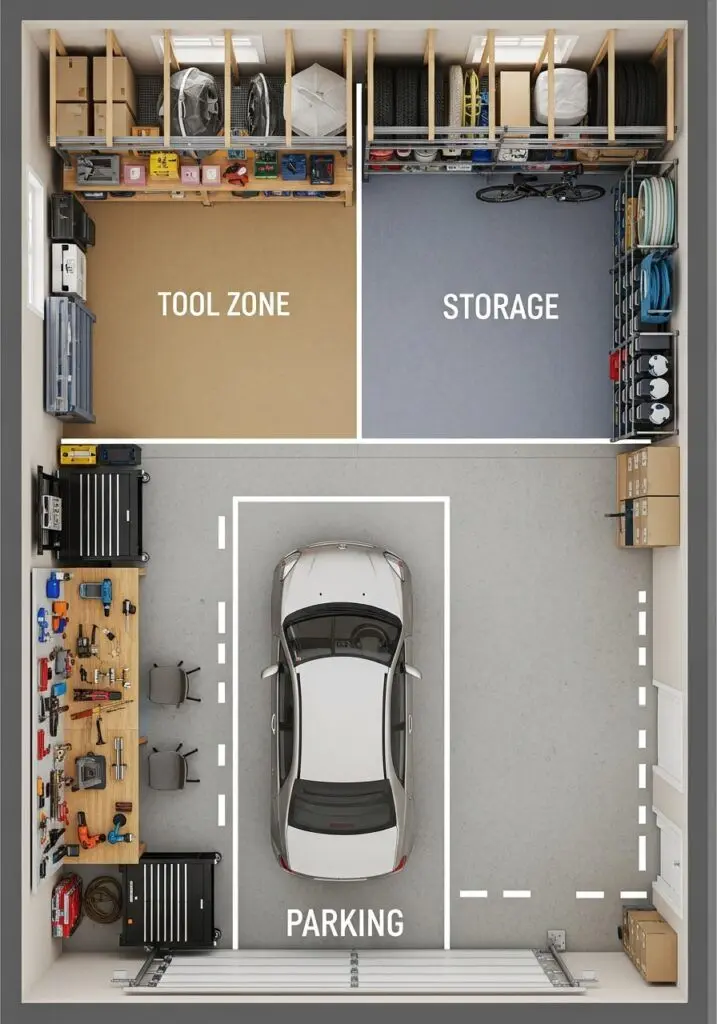
Layout Planning for a Functional 2 Car Garage
A thoughtful design optimizes the use of your garage. Consider:
- Parking space: leave a minimum of 3 feet beside the vehicles.
- Walking paths: Leave 23 feet around the back of the vehicles.
- Storage zones: Wall shelving or cabinets.
- Workshop area: Find a space to place the tools or a small workbench.
In designing, use 2 Car Garage Plans so that you can have the right fit of the door, windows, and storage. An intelligent design makes your garage organized, secure, and clean.
Understanding 2 Car Garage Plans
A functional garage is based on planning. Good drawings will allow you to visualize space, prevent errors, and manage costs. Regardless of the type of design you prefer, a standard design or a custom design, proper planning will make your garage fulfill your daily needs.
What is Included in 2 Car Garage Plans?
Most of the professional garage plans include floor structure, door placement, wall framing, roof structure, and electrical designs.
Custom vs Pre-Designed Layouts
Ready-made layouts are cheaper and quicker to accept. They are effective with a normal lot and vehicle sizes. Custom layouts, though, enable the homeowners to customize storage space, workshops, and the parking space. Custom-made designs are also 15-40% higher in cost, but offer greater longevity.
Importance of Proper Drawings
Accurate drawings prevent costly mistakes. They assist the contractors to estimate materials, follow local building codes, and design electrical and plumbing systems. There is also ease in acquiring permits as clear drawings can be easily approved, thus minimizing delays in a project.
Before finalizing garage plans, conducting a construction feasibility study can help ensure your layout fits your lot, budget, and local building regulations.
Prefab 2 Car Garage vs Custom Built
The decision between prefab and custom-built garages is based on the budget, time frame, and flexibility. Each of the two is good, yet the correct option is one that will affect the priorities.
What Is a Prefab 2 Car Garage?
Prefab 2-car garage is a pre-fabricated garage that is made off-site and erected on your premises. These garages are available in standard sizes, and they are packaged in the form of panels or entire structures, making them easy to install.
Pros and Cons
Pros:
- Faster construction
- Lower labor costs
- Predictable pricing
Cons:
- Limited customization
- Standard designs only
- May not match existing home architecture perfectly
Custom-made garages, however, are a bit more expensive and time-consuming, and this is due to the fact that fully designing the garage is possible.
Cost Comparison
Prefab garages will cost between $10000-25000 varying with size and construction materials. Personally constructed garages can cost between and over $25000 to $60000 especially when they are insulated, lined with good materials, and have a power supply. Ready-made models are cheap whereas custom models are a good investment in the long run.
Installation Time
Prefab garages are finished in 1-3 weeks, including foundation. Garages that are built specially are usually built in 2-4 months, and this is subject to permits and complexity. Prefab is the quickest solution in case time is at a premium.
Building Costs Based on Garage Size
Garage construction would vary depending on size, materials, and finishes. The average cost of construction of a garage is between $40 to $70 per square foot in basic construction. The costs may go to $100-$150 per square foot with insulation, electrical work, and the best finishes.
A standard 2 car garage size (20X 20) costs between $16 000 to $30 000. Better-material mid-range garages may go up to $35,000-$50000. Custom-built garages with larger sizes tend to cost more than $60000.
Big garages will demand more materials, labor, and foundation. Nonetheless, they also drive up the value of property. Housing statistics indicate that home resale values can increase by up to 10% with the addition of a garage.
Choosing the right 2-car garage size would be to make sure that you are not spending too much money, yet at the same time, that you get the required storage and parking.
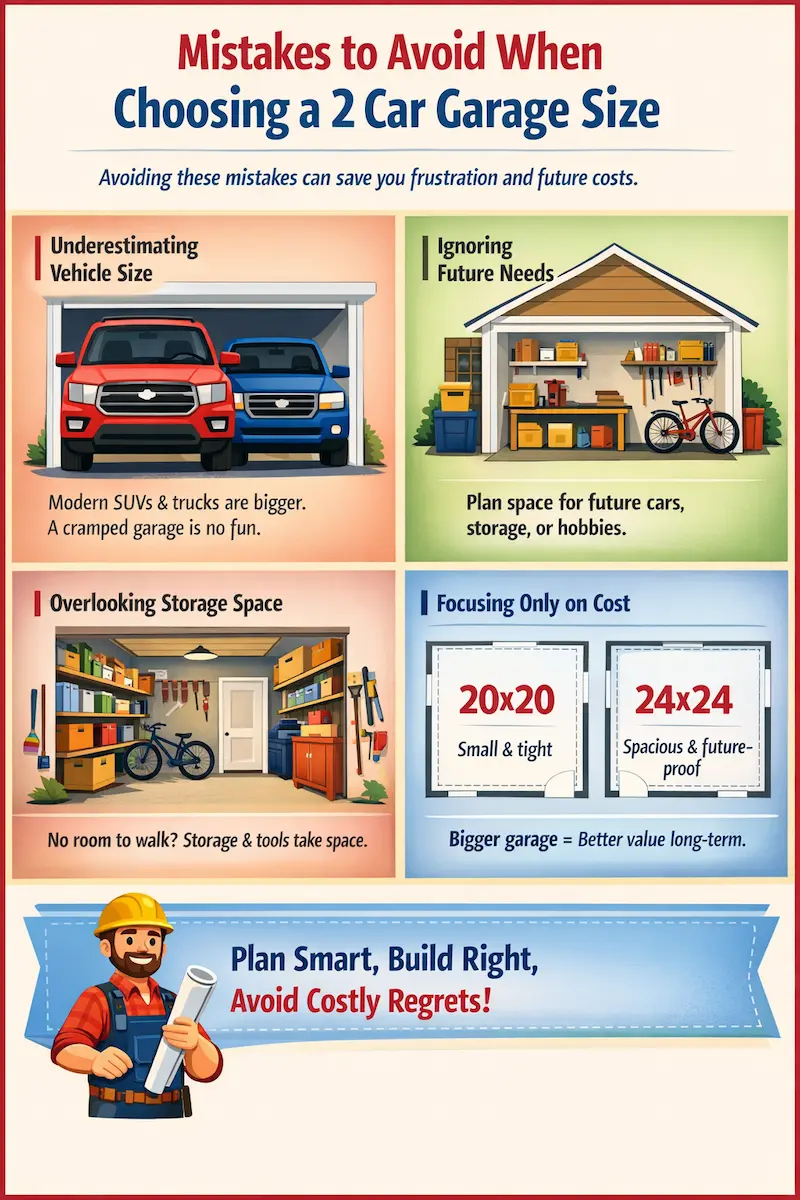
Mistakes to Avoid When Choosing a 2 Car Garage Size
Choosing the wrong size of the garage would entail frustration every day and costly refurbishment in the future. These are a few of the traps that an individual must avoid to make a wise choice.
1. Underestimating Vehicle Size
The new cars are bigger compared to older cars. The market has been overtaken by SUVs and trucks, which make up more than 60% of the new vehicle sales. A garage which is small can easily become crowded.
2. Ignoring Future Needs
Many homeowners plan for current vehicles only. Additional room will be needed in future purchases, storage, or for a hobby. It is usually cheaper to plan large now than it is to expand later.
3. Overlooking Storage and Walking Space
People often forget shelving, tools, and walking clearance. Garages start to be crowded and difficult to navigate without additional space.
4. Focusing Only on Cost
A comparison of a 20×20 and a 24×24 garage might not be the correct one to make in terms of pricing. The larger one is comfortable, has storage space and long-term value. The trivial cost at the moment would prevent untold refurbishment in the future.
It’s also wise to include a construction contingency in your plan to cover unexpected expenses during garage construction and avoid budget overruns.
Ready to choose between a fast prefab setup or a spacious custom build that fits your SUVs and storage needs?
Conclusion
Choosing the right size of the garage is not a joke for any homeowner. Its right design makes parking more comfortable, gives the property more storage areas, and adds value. The 2-car garage dimensions will help you make a good choice in planning, avoid spending on some expensive mistakes, and build the garage that suits your cars and way of life.
The options that have different advantages start with the 20×20 common layouts and 24×24 large ones. The trick is in finding a middle ground between space, money and future needs.
At Cost Estimator, we are here to let you know how big the garage will be, how the layout will be, and what the actual construction costs will be. So contact us right now
FAQs
How big is a 2 car garage?
The size of an average size of 2 cars garage is 20 x 20 feet to 24 x 24. This is a large size that can host two cars, storage and walking space. Larger garages are more convenient and accommodating of SUVs and trucks.
How wide is a 2 car garage?
Most of the 2 car garage ranges between 20-24 feet in diameter. The recommended width is 20 feet and the minimum width is 20 feet for comfortable parking and door clearance.
How many square feet is a 2-car garage?
The size of a typical garage (20 x 20) is 400 sq ft. A 24×24 garage is 576 square feet. Most garages have an average size of between 400 and 600 square feet.
How much does it cost to epoxy a 2-car garage?
The cost of epoxy flooring in a 2-car garage is around $3-$7 per square foot. A 400 600 sq ft garage will cost between $1200 to $4200, depending on the quality of coating and its preparation.
How wide is a 2-car garage door?
The size of a typical 2-car garage door is 16-18 feet wide and 7-8 feet high. The doors need to be wider and taller on the trucks, SUVs, and roof rack vehicles.